Village of Skadi
Map
Torvaldsland
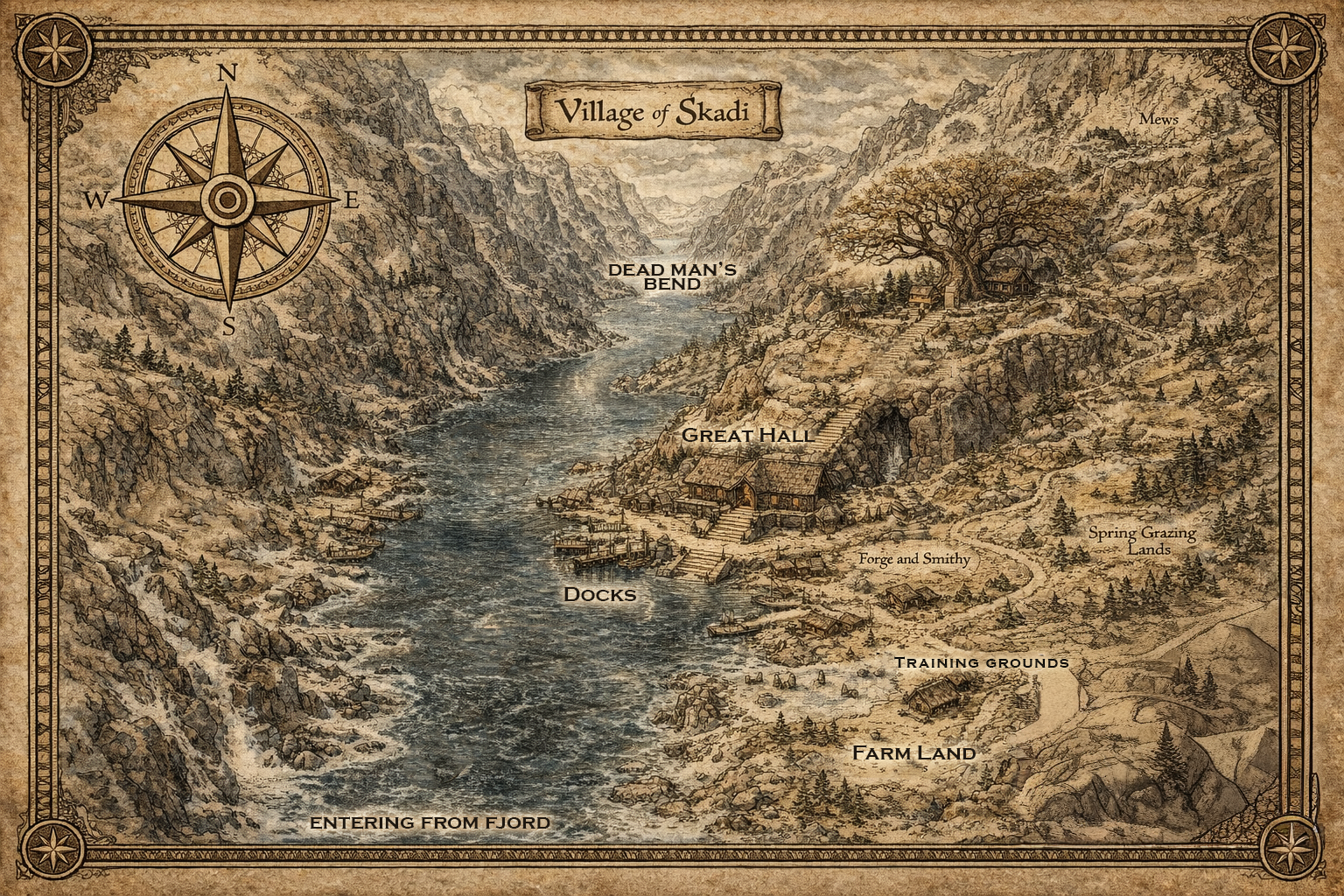
THE GREAT HALL (AS A PLACE OF PASSAGE) : The Great Hall is not entered lightly, nor does one linger without reason. From the Steps of Stone, all paths lead inward, through its doors, across its firelit floor. The Hall is the spine of Skadi — where news arrives, judgment is spoken, food is shared, and silence is respected. It is as much a thoroughfare as it is a gathering place. Those who pass through are seen. Those who remain are measured. Even when empty, the Hall holds presence. Fire is kept banked. Benches remain where they were last used. Nothing here feels abandoned. To walk the Hall is to walk within Skadi’s sight.
THE VILLAGE PATHS : The paths of Skadi were not planned. They were earned. Stone steps, packed earth, and worn trail wind through the village, following the mountain’s shape rather than defying it. Some paths are broad enough for sleds and beasts. Others narrow to single file, climbing sharply or vanishing briefly beneath snow and shadow. Footpaths connect docks to dwellings, dwellings to stores, stores to the Hall. Game trails branch outward, used by hunters and watched carefully. In winter, markers are set where snow erases edges. In thaw, mud is accepted without complaint. Those who walk the paths learn quickly where they lead — and where they do not. Shortcuts are known to locals. Strangers are advised not to take them alone. The mountain does not forgive those who hurry.
THE DWELLINGS OF SKADI : Homes in Skadi are built where the land allows, not where convenience suggests. Longhouses sit along the lower slopes and curved banks of the valley, close enough for community, far enough to grant space. Hill cabins rise higher, clinging to stone where wind scours snow clear. Each dwelling is built for warmth, endurance, and repair — stone foundations, timber walls, turf or weighted roofs. No two homes are alike. Some are shared by kin. Others by necessity. Some are old, bearing the marks of generations. Others are newer, still learning the mountain’s moods. Doors are kept sturdy. Hearths are kept ready. What hangs outside a home tells its own story — nets drying, tools resting, hides curing, birds tethered briefly before release. Privacy is respected. Need is answered. Excess is discouraged. A dwelling in Skadi is not a claim of ownership. It is a declaration of responsibility.
THE STOREHOUSES : Nothing in Skadi is left to chance, least of all winter. The storehouses sit close to the Hall but are built low and broad, their stone walls thick, their roofs weighted against wind and snow. They are dug partially into the earth and mountain, where cold can be kept and warmth resisted. Heavy doors are barred from the inside, not to keep thieves out, but to keep order in. Within are stacked crates, sealed jars, hanging meats, dried fish, grains, furs, tools, lamp oil, and preserved roots. Everything is marked by season and use. Nothing is wasted. Nothing is taken lightly. Those who enter the storehouses do so with purpose. Inventory is kept by memory and by practice, not idle counting. What is removed is replaced when it can be. What cannot be replaced is guarded. A village that does not know what it has does not survive the north.
THE SPAR AND TRAINING GROUND : Strength is not assumed in Skadi. It is maintained. The spar lies within sight of the Hall, set on packed earth and stone where footing can be tested and corrected. Posts are sunk deep into the ground for striking. Weapons used here are blunted or weighted for practice, though scars are not uncommon. The north teaches even when it is not asked. Men train here openly, often in silence. Shields are raised, lowered, broken, repaired. Stances are corrected. Breath is measured. This is not spectacle. It is preparation. At times, women train here as well — not always with blade, but with staff, spear, bow, or balance. Strength takes many forms. Skadi does not deny this. When storms come, training moves inward. When peace lingers, it does not soften discipline. A village that cannot defend itself does not deserve to endure.
THE LIVESTOCK PENS: Animals are not kept far from Skadi. They are kept close enough to be protected, but not so close as to foul the Hall. The pens sit along the lower valley floor where land opens enough for movement and care. Stone walls break the wind. Timber rails are reinforced against snow load and shifting earth. Shelter huts are built low and warm, lined with straw, hide, and packed turf. Bosk are kept here for meat, hide, bone, and labor. Verr are kept for milk, wool, and breeding stock hardy enough to survive northern cold. Draft bosk are used sparingly, valued more for endurance than speed. Each animal is known by its use. None are kept without reason. None are neglected without consequence. During the harshest months, fodder is rationed carefully. During the thaw, animals are moved to higher grazing lands where the grass returns first. The north does not forgive careless stewardship.
THE FORGE AND SMITHY: The forge is the heart that beats when the Hall sleeps. Set apart from dwellings but close enough for watch, the smithy is built of stone and soot-darkened timber. Its roof vents smoke high, its walls bear the marks of years of work. Iron sings here. Fire answers to practiced hands. Weapons are repaired before they fail. Tools are reforged before they break. Nails, hinges, fittings, fishhooks, harness rings, and trade goods are shaped here with equal care. The forge does not favor the sword over the plow. The smith is not interrupted lightly. Fire must be respected. So must the man who commands it. In Skadi, steel is not decoration. It is survival given form.
THE MEWS: High above the village, set into the mountain’s lee where wind breaks and sight carries, stand the mews. Here are kept the birds of Skadi — hunting birds, scouting birds, and messengers. Each has its place. Each has its handler. None are treated as ornaments. The mews are stone-backed and timber-fronted, open enough for air, closed enough for warmth. Perches are set with care. Feeding is exact. Training is slow and patient. Some birds are trained to flush small game. Others to mark large prey for hunting parties. The vulo carry messages when paths are closed or too dangerous for runners. They are released sparingly. A bird lost is not easily replaced. The birds see what men cannot. Skadi listens.
THE DOCKS AND WORKING SHORE:The docks are not welcoming. They are functional. Stone piers extend into the sheltered basin where the fjord ends. Longships and serpent-prowed vessels are moored carefully, bows turned for quick release if needed. Smaller fishing craft rest closer to shore, pulled up or lashed tight. Nets are mended here. Ice is cut and hauled. Fish are cleaned and salted. Boats are repaired where they land, not where they look best. Those arriving by water are seen before they are heard. Those departing do not linger. Skadi is not a port of trade. It is a place of passage and purpose.
THE SPRING FIELDS AND GRAZING LANDS: Beyond the immediate stone and timber, where the valley opens and the snow thins first, lie the spring lands. These fields are worked only when the ground allows it. No man forces the earth here. Planting follows thaw, not hope. Grazing is rotated carefully to avoid stripping the land bare. Game trails cut through the edges of forest and field alike. Hunters know them well. Strangers are warned not to wander them alone. The land provides when it is respected. When it is not, it takes payment.